What dilution should you use for an alkaline pre-wash in Sri Lanka?
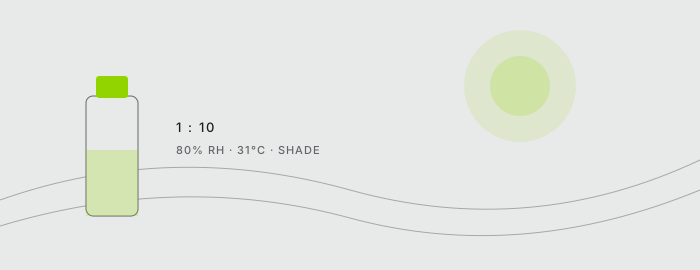
Use 1:20 for a general pre-wash and 1:10 for engine bays and heavy road film. In Sri Lankan humidity go one step weaker than the German label suggests, work strictly in shade, and never let the solution dry - 60 to 90 seconds of contact, then rinse.
That is the whole answer, and you can stop reading here if that is all you came for. What follows is why the number changes with the weather, and what happens in the bay when you get it wrong.
Why Colombo humidity changes the number
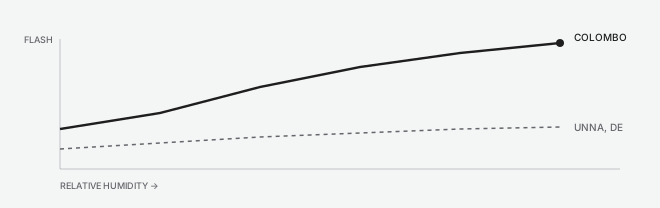
Koch-Chemie writes its dilution ranges for a European workshop: roughly 20°C and 50% relative humidity. Colombo sits closer to 31°C and 80%, and a Kandy afternoon can go higher. Heat speeds the reaction up; humidity slows evaporation down. Those two pull in opposite directions, and the practical result is a solution that stays wet longer but works harder while it is there.
Dew point and flash time
The failure everyone recognises is white streaking on dark paint. That is alkaline residue that dried before it was rinsed. It is far more likely on a panel sitting in direct sun at 45°C surface temperature than on the same panel in a shaded bay, which is the single biggest variable you control.
Working in a shaded bay
If you have a roof, use it. If you do not, wash before 09:00 or after 16:00 and work one panel at a time. Two panels wet at once in March sun is how you end up polishing out your own streaks.
Choosing the dilution for the job
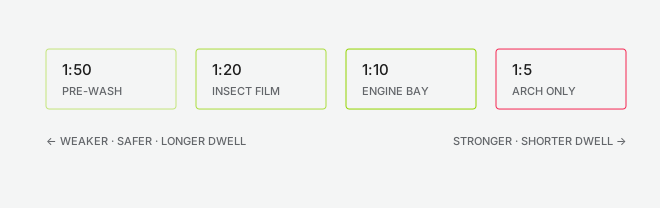
Start weak. You can always go a step stronger; you cannot un-etch trim. A litre of Green Star at 1:20 gives you 21 litres of working solution, which is three or four cars - so the strong-by-default habit is expensive as well as risky.
Monsoon versus dry season
During the southwest monsoon, from May through September, rinse water sitting on a panel is doing half your work for you. Weaker dilutions perform better. In February and March, when panels are hot and dry, go one step stronger but halve your dwell time.
A note on wheel arches
1:5 is appropriate for arch liners and nothing else. Keep it off bare alloy entirely.
The two-bucket sequence, adapted
The standard method still applies, with one change for our conditions: keep a third bucket of clean rinse water in the shade purely for the mitt, and change it every second car. Grit suspended in warm water settles more slowly, which is why a mitt that looks clean in Colombo often is not. Koch-Chemie publishes the underlying surface-chemistry reasoning in its own technical documentation.
Three mistakes we see most often
Mixing into hot water, which accelerates flash-off. Spraying a full car at once. And decanting concentrate into an unlabelled bottle, which is both a safety problem and the fastest way to lose track of what dilution you actually mixed.